
The $7 Billion Question Sitting Under Veeva's One-Third Drawdown
A wide-moat, debt-free compounder just got marked down a third. Whether that's a gift or a warning comes down to a single ratio almost nobody is tracking.

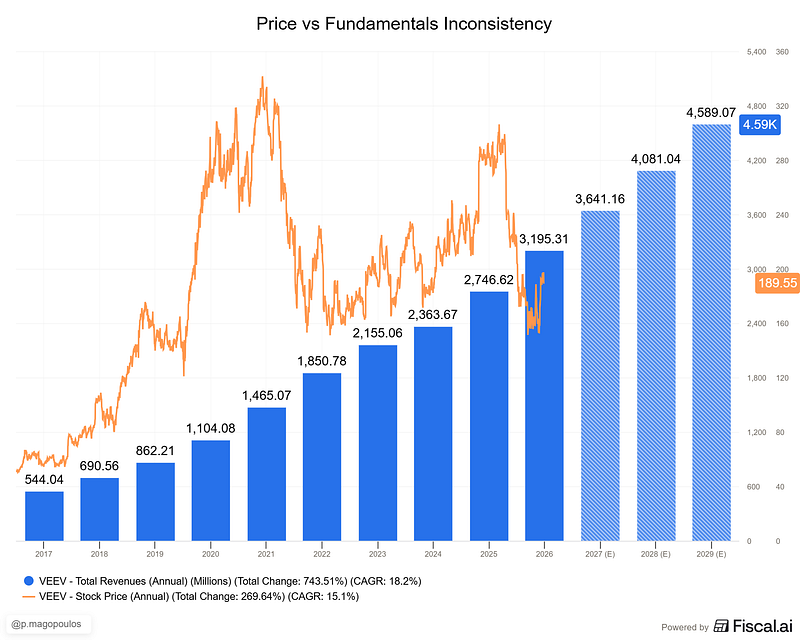
Veeva Systems ran to roughly $310 last year. It now trades in the $190s — call it a one-third correction in a business that, over the same window, did nothing but get better.
Fiscal Q1 2027: revenue up 16% to $882.9M. Non-GAAP operating margin holding near 45%. Second consecutive guidance raise. A debt-free balance sheet carrying ~$7.3B in net cash. Free cash flow margin at a five-year high of 44.3%.
So the reflex — “software got de-rated, quality name on sale, back up the truck” — writes itself.
I don’t think the reflex is wrong. I think it’s dangerously incomplete. Because underneath this specific drawdown is a variable that decides the entire thesis, and it has nothing to do with the multiple.
What The Market Actually Repriced
Three things got marked down here, and only one of them matters.
The first is just sector beta — high-multiple software got repriced on AI-disruption fear, and Veeva went along for the ride. The second is real but known: CRM new-logo growth has decelerated because the top-50 pharma list is essentially fully penetrated. That’s arithmetic, not deterioration — and it’s increasingly irrelevant, because R&D & Quality Cloud (Vault) is now the larger segment and the actual growth engine.
The third is the one that keeps me up at night, and it’s the reason this isn’t a simple “buy the dip.”
The Non-Compete Nobody Was Watching Just Expired
For roughly 15 years, Salesforce was contractually barred from competing in life sciences CRM. That non-compete expired in September 2025.
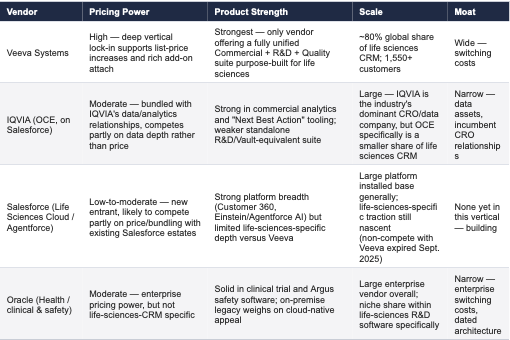
Salesforce has since launched Life Sciences Cloud — and partnered with IQVIA, Veeva’s oldest data-and-analytics rival, to jointly market a competing CRM. This is the first credible multi-front competitive threat in Veeva’s entire history, and it lands at the exact moment Veeva is doing something audacious: ripping its own CRM installed base off Salesforce’s infrastructure and onto its own Vault platform by 2030.
Management is winning that migration — roughly 80% of contested accounts, 150+ customers live, 40+ full migrations done. But they’ve also conceded that a handful of top-20 biopharma accounts are expected to defect to the Salesforce/IQVIA alliance.
So here’s the setup the market is fumbling: a self-inflicted platform migration, running straight into the first real competitor Veeva has ever faced, at the precise moment the stock is already down a third.
Why This Isn’t A Coin Flip — And Isn’t A Layup
The moat is real: switching costs in a GxP-regulated environment are brutal to unwind — ripping out validated workflows risks data-integrity failures and, worst case, a delayed drug launch, where the patent clock makes lost time extraordinarily expensive. That asymmetry is why Veeva defends pricing while add-on module penetration has climbed from under 10% in 2015 to 50–60% today.
The returns are real: ROIC of ~29–31% on operating capital against a ~9–12% cost of capital. That’s a ~1,700–2,000 bps spread — a company genuinely creating value, not renting it from a low discount rate.
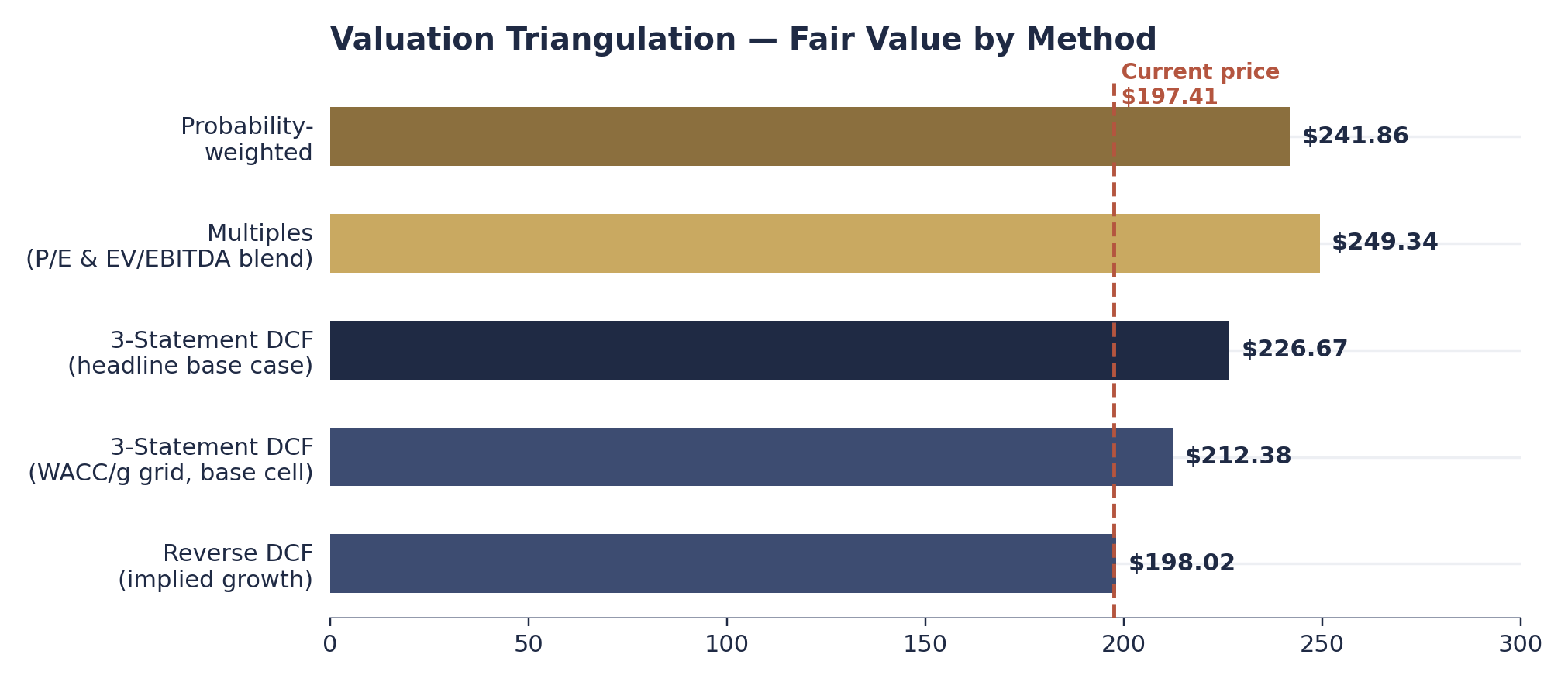
And the valuation genuinely triangulates to upside across three independent methods — DCF, reverse-DCF, and peer multiples — with a favorable reward-to-risk skew.
But every one of those “reals” is a growth-durability call, not a re-rating call. If the migration losses stay contained, this is asymmetric. If they broaden, the moat thesis — and the valuation resting on it — cracks.
The One Ratio That Settles It
Everything above collapses into a single number that I track every quarter — and it is not revenue growth, which is exactly what everyone else fixates on.
It’s the pace of Vault CRM migration completions relative to the customer-loss cohort management has already flagged. That ratio, more than any earnings line, tells you whether the switching-cost moat is holding or quietly eroding under the cover of a “sentiment de-rating.” Get that ratio right and the valuation case answers itself. Get it wrong and every DCF in the world is decorating a value trap.
In the full report, I lay out:
The exact three-method valuation triangulation and where fair value actually clusters
The probability-weighted reward/risk figure and how the scenarios are weighted
The full 7-factor risk table with my own severity and probability estimates over a 12–24 month horizon
The specific quarterly tripwire on the migration ratio that would flip this from asymmetric long to exit
The bull/bear framing and the position-sizing logic tied to conviction
That’s the 25-page initiation. It’s for paid subscribers.
👉 The full Veeva initiation — valuation, risk table, and the migration tripwire that decides the whole thesis — is available to subscribers. Subscribe below.
Disclaimer
This article represents personal analysis and reflects solely the personal views of the author. It does not constitute investment advice, a recommendation to buy or sell any financial instrument, or an offer of investment services under MiFID II or applicable Greek capital markets law. The author does not act in the capacity of a licensed investment advisor. Information is based on publicly available data and its accuracy or completeness is not guaranteed. Any investment decision should be made following your own research and/or in consultation with a licensed professional. The author and/or affiliated persons may hold a position in the security referenced.